
Guide
Accountability: Authority vs. Influence
Two ways to see accountability, and five practices for holding someone accountable when you aren't their manager.
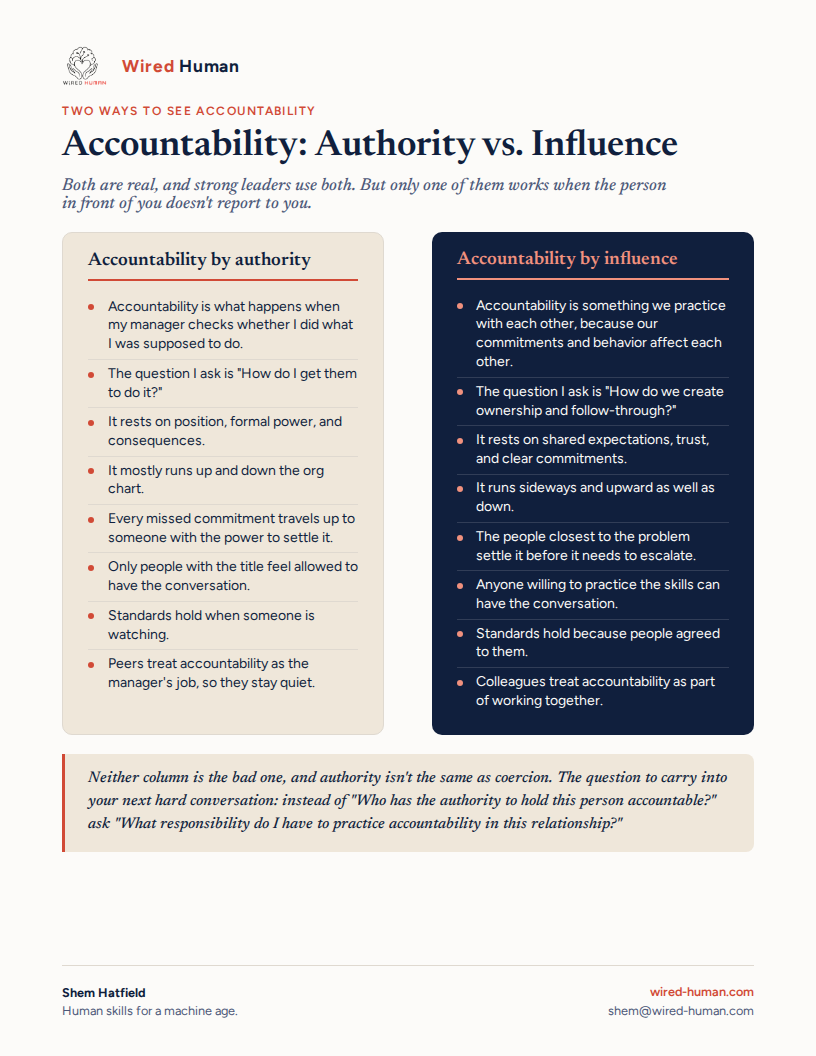
Accountability and authority are not the same thing. Authority is the power to direct someone's behavior. Accountability is the practice of making commitments, actions, and results answerable, and anyone willing to learn the skills can practice it, with or without a title.
Most organizations lean on authority: a missed commitment goes up to a manager, and the manager deals with it. That works when you are the manager. It stops working the moment you need something from a peer, another department, or a partner who doesn't report to you. The skills are the same, but you have to be more deliberate about using them.
Three different things you can do
"Hold someone accountable" can mean three different things, and only one of them requires authority.
- Invite accountability. Ask questions, name a concern, give feedback, and invite the other person to look at their own choices. Available to anyone.
- Create mutual accountability. Agree on shared expectations, get specific commitments, and settle who owns what. This takes some shared understanding, which you can build.
- Enforce formal accountability. Apply the organization's processes and consequences when standards aren't met. This depends on legitimate authority.
Practicing accountability doesn't mean taking responsibility for someone else's choices. You can own how you show up in the conversation. What the other person does with it remains theirs.
Open, Resourceful, Persistent
These three habits carry an accountability conversation, whether or not you are in charge.
- Open. Get curious before getting corrective. Your view may be incomplete. Try: "Help me understand what's happening on your end."
- Resourceful. Move from frustration to what would make success possible. Try: "What would help us move this forward?"
- Persistent. Turn the conversation into a commitment and then follow through. Try: "What are we each committing to, and when should we reconnect?"
Persistent doesn't mean repeating the same conversation. It means staying committed to a responsible outcome, which sometimes means changing your approach, renegotiating the agreement, or bringing in the people who can settle a conflict you can't.
Five practices for holding a peer accountable
- Set shared expectations before there's a problem. Don't assume two teams share the same idea of urgency or success. "Can we clarify what each of us needs from the other for this to work?"
- Make the impact visible without making the person the problem. Describe the missed commitment and what it caused. Leave out guesses about intent or character. "When we don't have the information by Wednesday, our team can't start the next step."
- Get curious about their reality. A missed commitment doesn't automatically mean they don't care. Priorities may conflict or ownership may be unclear. "What am I missing about what you're dealing with?"
- Make clear commitments on both sides. Turn a good conversation into an agreement: who does what, by when, and how you'll tell each other if something changes. "What can we realistically commit to?"
- Follow through without turning it into a fight. Revisit the agreement, acknowledge progress, and name the gap if it persists. "We agreed on Friday and we're still waiting. What needs to happen to get this back on track?"
What it sounds like
Two department managers. One needs information from the other, and two deadlines have passed. The first manager has no authority over the second.
Authority-style: "I've asked you twice. I need this done. If you don't get it done, I'm going to your manager."
Influence-style: "Can we talk about the project for a minute? We've missed the last two dates for getting the information, and it's starting to affect what our team can deliver. I know you're juggling a lot, so I'm curious what's happening on your side. What feels realistic for getting this done? And how can we tell each other early if something changes?"
The second version still has an expectation in it. It's direct without being adversarial. And if the problem continues, the next step can be just as plain: "We've revisited this a couple of times and we still haven't met the timeline. I think we need to bring our managers together to sort out priorities." Sometimes the most responsible use of influence is recognizing the problem needs a decision you can't make yourself.
The question to carry
Is accountability something we do to people, or something we practice with them? Organizations do have legitimate expectations and consequences, and some breaches have to be answered for. But as a way of leading, practicing accountability with people shifts the focus from control to shared ownership.
Try swapping one question for another. Instead of "Who has the authority to hold this person accountable?" ask "What responsibility do I have to practice accountability in this relationship?" The first sends the problem up the chain. The second puts it where it can actually be solved: in the relationship.
If your team treats accountability as the manager's job, or you're a leader trying to build it between peers, Compassionate Accountability® training gives a team practice with exactly these conversations. Get in touch and describe the one you keep avoiding.