
Guide
Delegating vs. Dumping
Two columns that show the difference between handing someone a task and actually developing them through it.
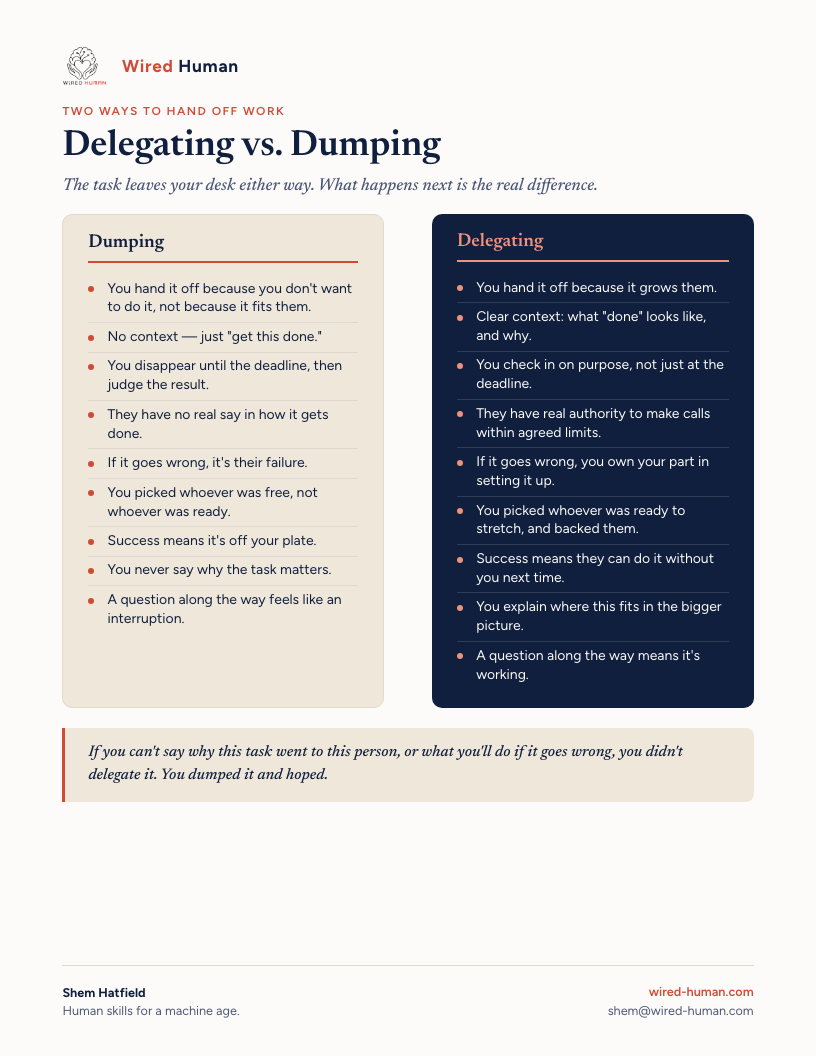
From across the room, delegating and dumping look identical. A task leaves your inbox and lands on someone else's. The difference never shows up in the handoff itself — it shows up in what you did before it and what you do after it. Most leaders who dump work don't mean to. They're just moving fast, clearing their plate, and calling it trust.
The cost shows up later. Dump enough tasks on someone without context or authority, and you get a person who executes instructions without ever growing into the role — then gets blamed when something goes wrong that they were never actually equipped to prevent. Delegate the same volume of work with real ownership attached, and you get someone who can eventually do the job without you. Same number of tasks handed off. Completely different outcome.
Dumping
- “Here, this is yours now” — no context on why it matters.
- You hand off the task, not the reason behind it.
- You hand off the parts of your job you don't want, not the parts that would grow someone.
- You disappear until the deadline, then show up to judge the result.
- You never said what “done” looks like, so you can't fairly say they missed it.
- You gave the responsibility but kept the authority to make real decisions.
- You only step back in when something's already gone wrong.
- You assume they'll figure out the constraints and priorities on their own.
- If they fail, that's on them — you already handed it off.
Delegating
- You explain why this task matters and where it fits in the bigger picture.
- You hand off the outcome and let them find their own way to it.
- You hand off work that stretches someone, not just work you're glad to be rid of.
- You check in before the deadline, not just at it.
- You agree on what “done” looks like before they start, not after.
- The authority you hand off matches the responsibility you're asking them to carry.
- You stay reachable without hovering over the work.
- You ask what support they'll need instead of waiting for them to ask you.
- You stay accountable for the outcome even after the task belongs to them.
If you can't say why this task went to this person, or what you'll do if it goes wrong, you didn't delegate it. You dumped it and hoped.