
Guide
Feedback That Lands vs. Feedback That Gets Nodded At
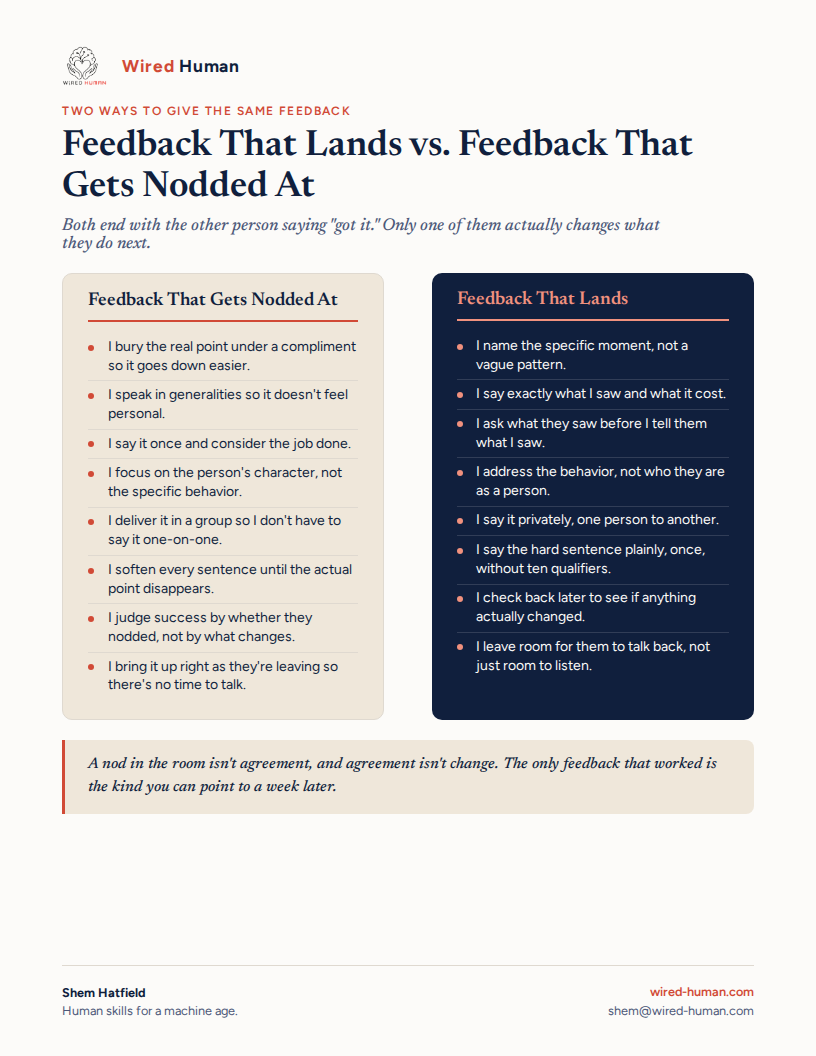
Two columns that show the difference between feedback someone nods at and feedback that actually changes what they do next.
A manager sits down with someone, raises a real concern, and the conversation ends well. "Got it, thanks" — the person nods, the tone stays warm, nobody's upset. Two weeks later the exact same problem shows up again, and the manager is genuinely stumped, because the feedback landed fine in the room. That's the trap: a nod tells you the conversation went smoothly. It never tells you whether anything is actually going to change afterward.
Those are two different outcomes, and most feedback gets optimized for the wrong one. It's easier to measure whether someone agreed with you in the moment than to measure whether their behavior is different a month from now, so a lot of feedback quietly aims for the easy target — a comfortable conversation — instead of the hard one. The difference isn't how nice the delivery was. It's whether the feedback was specific enough to act on, aimed at a behavior instead of a person, and followed up on instead of left to fade.
What produces a nod, not a change
- Burying the real point under a compliment so it goes down easier
- Speaking in generalities so it doesn't feel personal
- Saying it once and considering the job done
- Focusing on the person's character instead of the specific behavior
- Delivering it in a group instead of one-on-one
- Softening every sentence until the actual point disappears
- Judging success by whether they nodded, not by what changes
- Raising it right as they're walking out, with no time left to talk
What actually changes behavior
- Name the specific moment, not a vague pattern
- Say exactly what you saw and what it cost
- Ask what they saw before you say what you saw
- Address the behavior, not who they are as a person
- Say it privately, one person to another
- Say the hard sentence plainly, once, without ten qualifiers
- Check back later to see if anything actually changed
- Leave room for them to talk back, not just room to listen