
Guide
Managing Time vs. Managing Energy
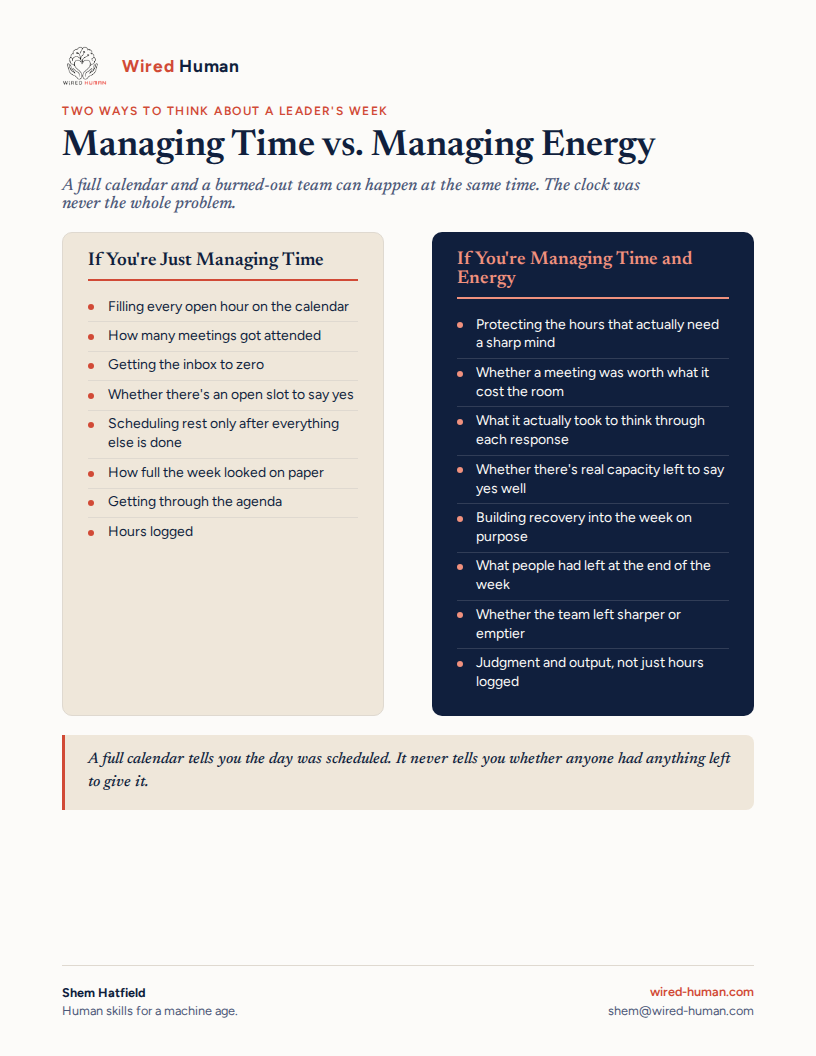
Two columns showing exactly what changes when you manage energy alongside time, one focus at a time.
A leader can run a tight calendar and still lose their best people. Every hour is accounted for, meetings start on time, the inbox gets to zero most days, and by every visible measure the week worked. Then a strong performer gives notice, or a normally sharp team goes quiet in meetings, and the leader is genuinely confused, because the schedule never showed a problem. It wasn't built to. A calendar tracks hours. It has no way to show what a person had left after the hours were spent.
Time and energy look like the same resource from the outside, but they run out differently. Time is spent in fixed units you can see coming, an hour is an hour, and a full calendar is easy to point to as proof of a hard week. Energy is spent unevenly, and it doesn't reset on a fixed schedule. A single tense meeting can cost more than three easy ones combined, and a person can sit through a perfectly reasonable eight-hour day and still leave with nothing left for their family that night. The fix isn't a different calendar. It's a different focus, item by item, on what that calendar is actually for.
What managing time alone focuses on
- Filling every open hour on the calendar, whether or not it's the right hour for anything that matters
- Counting how many meetings got attended, not what they actually cost the people in them
- Getting the inbox to zero, regardless of what it took to get there
- Treating an open slot on the calendar as reason enough to say yes
- Scheduling rest only after everything else on the list is already done
- Judging a good week by how full it looked on paper
What managing time and energy focuses on instead
- Protecting the hours that actually need a sharp, rested mind
- Weighing whether a meeting was worth what it cost the room, not just whether it happened
- Paying attention to what a response actually took to think through, not just whether it got sent
- Asking whether there's real capacity left to say yes well, not just an open slot
- Building recovery into the week on purpose, instead of hoping the weekend covers it
- Judging a good week by what people had left at the end of it, not by how full it looked