
Guide
Reacting vs. Responding
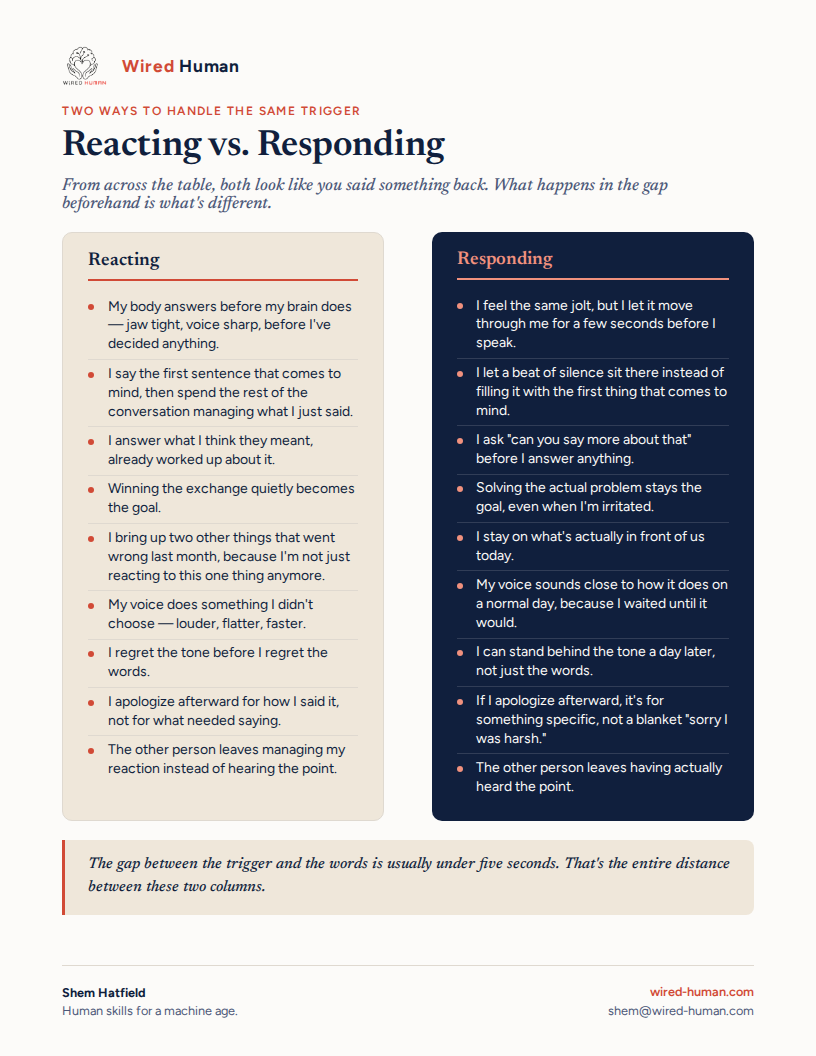
Two columns that show what actually happens in the pause between being triggered and choosing what to say next.
A leader gets challenged in a meeting, feels the heat rise before they've had a chance to think, and answers with a tone harder than they meant. The wrong point gets defended, the actual issue never gets addressed, and everyone in the room remembers how it was said longer than they remember what was said. The next time something goes wrong, the team is more careful about what they bring to that leader — not because the facts changed, but because the reaction did.
This isn't a character flaw or a discipline problem. It's how a stressed nervous system works: a fast, physical answer to a threat shows up before a slower, more useful one has time to catch up. Left unmanaged, that gap disappears, and every hard conversation gets run by the fastest part of the brain instead of the most useful one. The same gap that produces the bad reaction is exactly where a better response has room to happen — it just has to be noticed and used, on purpose, every time.
What reacting looks like
- The body answers before the brain does — a tight jaw or a sharper voice before anything has actually been decided
- The first sentence out is whatever came to mind first, and the rest of the conversation goes to managing it
- The answer is to what you assumed they meant, not what they actually said
- Winning the exchange quietly replaces solving the problem
- Old, unrelated grievances get pulled into a conversation that was never about them
- The voice does something nobody chose — louder, flatter, faster than normal
- The tone gets regretted before the words do
- Any apology afterward covers how it was said, not what needed to be said
What responding looks like instead
- Notice the physical jolt and let it pass for a few seconds before speaking
- Let a real beat of silence sit there instead of rushing to fill it
- Ask a clarifying question before answering anything
- Keep the actual problem as the goal, even while irritated
- Stay on what's actually in front of you today
- Let the voice settle back to normal before it does the talking
- Say only what you'd still stand behind a day later
- Save any apology for something specific, not a blanket "sorry I was harsh"